Bird Sound Classification
Identifying bird species from field recordings by turning sound into pictures.
- Timeline
- 2025 · Complete
- Role
- Solo
- Modality
- Audio
- Evaluated on
- Confusion-matrix error analysis
- Multiclass accuracy
- 71.9%
- Species
- 12
- Held-out confidence
- 78–85%
- Binary task
- 100%
The problem
Biodiversity monitoring needs to know which species are present in an area, and doing it by ear at scale is not feasible. Field audio is also genuinely awful input: variable length, variable quality, background noise.
What I built
An end-to-end deep learning pipeline that converts raw MP3 field recordings into STFT spectrograms and trains CNNs to classify 12 bird species. The preprocessing stage does the unglamorous work: 22050 Hz resampling, 2-second windowing, decibel-scaled spectrograms, normalization. The core idea is that a sound becomes a 2-D image, at which point convolutional networks apply.
How I knew it worked
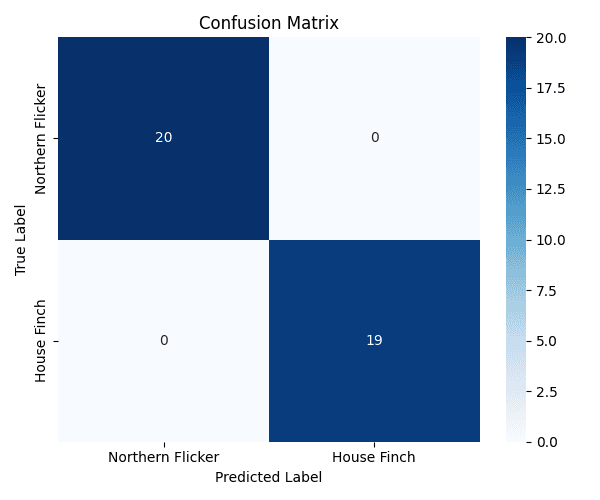
71.9% multiclass accuracy across 12 species, 100% on the binary task, and 78–85% confidence on held-out field recordings the model had never seen. More useful than the headline number was the error analysis: the confusion matrix showed the model mixing up House Finch and White-crowned Sparrow specifically, which traced to genuinely similar call structures rather than to a modelling bug. Knowing which classes fail and why is what tells you whether the next change will help.